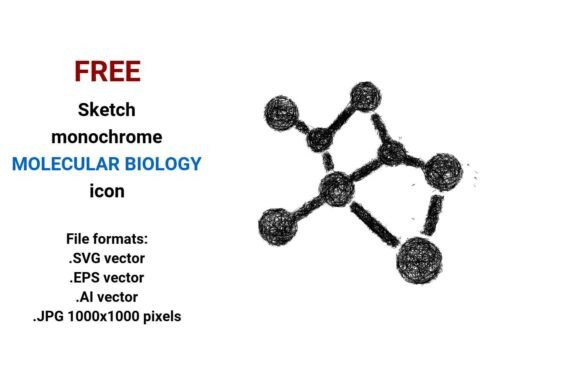
FREE Sketch Cell Study Icon
A Designer’s First Glance: Clean, Quiet, and Scientifically Sincere
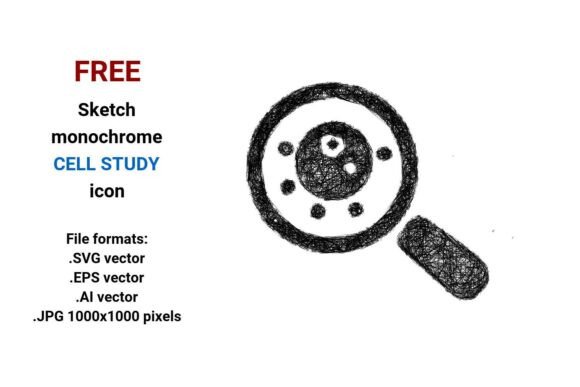
When I opened the FREE Sketch Cell Study Icon, my first thought wasn’t “Wow!”—it was “Yes. This feels right.” It’s a hand-drawn-style black-and-white cell illustration: no clutter, no forced cuteness, no lab-coat clichés. Just a single, well-proportioned eukaryotic cell with subtle nucleus detail, membrane contours, and light sketch-line texture. It reads as thoughtful—not clinical, not cartoonish—but grounded in real biology. That tone matters deeply when you’re stitching it onto a baby onesie for a pediatrician’s office gift or embroidering it on an apron for a university science outreach booth. It doesn’t shout; it invites curiosity.
Where It Lives Best: Real Projects, Not Just Pixels
I tested the FREE Sketch Cell Study Icon across three actual small-batch projects: a linen tea towel for a local biotech co-op shop, a 3-inch embroidered patch sewn onto organic cotton tote bags for a high school AP Bio fundraiser, and a minimalist sweatshirt design for a science educator’s Etsy store. In every case, it held up—not because it’s flashy, but because its restraint works *with* fabric, not against it.
- Tote bags & tea towels: The clean vector lines translate beautifully into medium-density fill stitch. No jagged edges, no lost detail—even at 2.5 inches wide, the nucleus contour remains legible.
- Sweatshirts & baby bodysuits: Because it’s monochrome and low-detail, it avoids the “overstitched” look that plagues busy icons on thick or stretchy knits. Paired with soft tear-away stabilizer and matte polyester thread, it feels handmade—not machine-made.
- Patches & caps: Here’s where caution kicks in. On curved cap fronts, I resized it to 1.75" max and simplified the outer membrane line slightly (just a quick vector tweak in Illustrator). The original holds fine—but only if your hoop clears the curve cleanly.
What You’ll Want to Watch—Not Flaws, Just Fabric Realities
This isn’t a “plug-and-stitch” design for every surface. Its quiet strength means it also has quiet limits—and knowing them saves time, thread, and client trust.
- Small hoops & dense fabrics: Below 2 inches, the internal cell structures start to blur in fill stitch. If you’re embroidering on thin cotton poplin or rayon challis, consider using running stitch outlines only—or convert the center to a light satin stitch ring instead of full fill.
- Dark or textured backgrounds: Since it’s black-and-white, contrast depends entirely on your thread choice. On navy twill or charcoal fleece, white or cream thread reads clearly—but avoid pale grey or off-white. Always test on scrap with your exact fabric + stabilizer combo.
- Frequent-wash items (baby clothes, kitchen towels): Keep stitch density moderate. Overly dense fills on delicate cell outlines can pucker or crack after repeated laundering. A balanced 30–40% fill density with clean underlay gives durability without stiffness.
- Commercial use & gifting: Customers notice authenticity. This icon feels like it belongs on a lab notebook cover or a grad student’s backpack—not a mass-produced novelty tee. That builds credibility for your craft business, especially if you serve educators, researchers, or wellness-adjacent brands.
Design Judgment, Not Just Decoration
As someone who’s reviewed hundreds of embroidery files for Etsy sellers and boutique makers, I judge icons like FREE Sketch Cell Study Icon by how they behave *after* stitching—not just how they look on screen. Does it enhance the product’s story? Does it feel intentional, not tacked-on? Here, yes. It adds quiet authority to a teacher’s personalized mug wrap. It lends warmth to a baby’s nursery pillow cover without veering into “cute overload.” And for digital product sellers, the included .SVG, .EPS, .AI, and .JPG files mean you can adapt it seamlessly—for printable mockups, layered SVG kits, or even sublimation-ready assets—without losing fidelity.
Practical Notes from My Embroidery Hoop
Before you load it into your machine or list it in your shop:
- Always test on scrap fabric—especially with your chosen stabilizer and thread. Sketch-style lines react differently on bamboo jersey vs. canvas.
- Review stitch density in your embroidery software. If the file came as a digitized embroidery file (not just vector art), check for nested underlay or excessive jump stitches—those impact smoothness on curved seams.
- Confirm hoop size compatibility. The vector is scalable, but your machine’s smallest stable hoop may limit usable minimums—especially for tight corners like pocket flaps or cuff bands.
- Inspect small details at 2x zoom in your vector editor. The nucleus outline looks fine at 100%, but tiny gaps or overlapping paths can cause digitizing hiccups later.
- Mock it up in black AND white backgrounds. What reads elegantly on ivory linen may vanish on heather grey. Use your .JPG for fast previews.
- Verify licensing before selling finished items. It’s labeled “FREE”—but check whether commercial use (e.g., embroidered patches sold on Etsy) is explicitly permitted. When in doubt, contact the creator.
Final Thought: A Quiet Design That Earns Its Place
The FREE Sketch Cell Study Icon won’t go viral on Pinterest—and it shouldn’t. Its value lies in its precision, its calm intelligence, and how naturally it integrates into thoughtful handmade work. It’s the kind of graphic that makes a science-themed baby shower gift feel personal, not generic. That’s rare. For embroidery designers building trusted small shops—or educators launching their first merch line—it’s not just another freebie. It’s a quietly capable design asset, ready to stitch with integrity.